Liftoff Adaptive Learning: The Secret Tool Schools Use to Fix Learning Gaps

Helping struggling students catch up is not easy. In every classroom, students learn at different levels. Some are doing well, some are ahead, and others are still trying to understand basic skills from earlier grades.
Many students miss important foundations. When those basics are weak, learning new topics becomes difficult. Regular worksheets and extra teaching can help, but they don’t always fix the real problem.
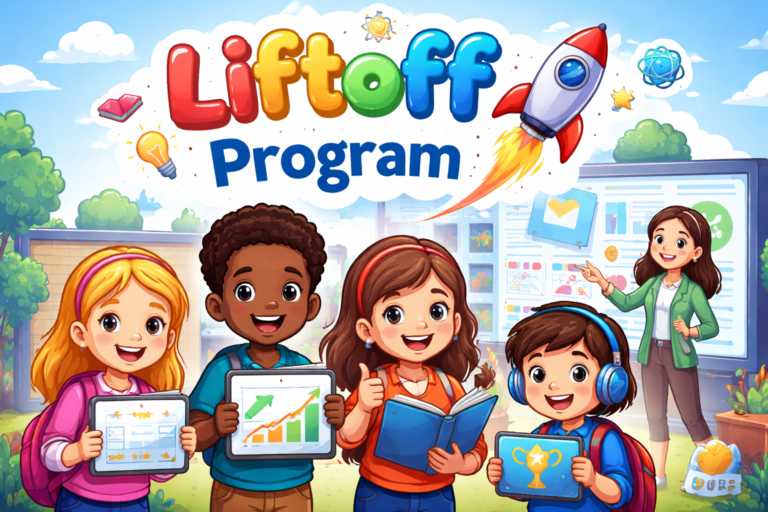
That’s where Liftoff, a part of the Progress Learning platform, helps. It is designed for students in Grades 2 to 8. It focuses on building strong basics step by step in math, reading, and science.
Schools mainly use it for extra support (intervention), but it also works for practice and revision.
What Is Liftoff and How It Helps
Liftoff first finds what a student does not understand. Then it starts teaching from that level. For example, if a Grade 6 student struggles with decimals, the real issue might be weak fractions. Liftoff goes back, teaches fractions properly, and then moves forward again.
This approach helps students:
- Understand concepts clearly
- Build confidence
- Learn faster over time
Instead of just practicing questions, it fixes the real learning gap.
Subjects Covered in Liftoff
Math Support
Math is one of the biggest challenges for many students.
Liftoff helps with:
- Basic operations
- Multiplication and division
- Fractions and decimals
- Percentages
- Ratios
- Introductory algebra
- Word problems
Students start from their actual level and slowly move up.
Reading and English (ELA)
Reading is important for all subjects.
Liftoff improves:
- Reading understanding
- Vocabulary
- Grammar
- Sentence structure
Students read passages, answer questions, and learn from their mistakes.
Science Practice
Science is also included in Liftoff.
Students learn:
- Key science concepts
- Important terms
- Practice questions based on standards
This helps in exams and understanding topics better.
How Students Get the Right Level
Before starting, Liftoff checks the student’s level.
Diagnostic Test
Students take a short test that checks:
- Current skills
- Previous knowledge
- Missing basics
MAP Score Option
If the school uses MAP testing, scores can be added directly. This saves time and gives accurate results.
After this, Liftoff creates a learning plan for each student.
How Liftoff Adjusts Learning
Liftoff changes the difficulty based on student performance.
- If students answer correctly → questions get harder
- If students struggle → it goes back to easier concepts
- When they improve → they move forward again
This keeps learning balanced and stress-free.
Fun Learning with Space Theme
Liftoff uses a space theme to make learning interesting.
Students can:
- Create avatars
- Build rockets
- Move through different “galaxies”
This makes learning feel like a game, not a task.
Rewards System
Students stay motivated with rewards like:
- Stars
- Cards
- Mini games
- Rocket upgrades
Even small progress is rewarded, which builds confidence.
Help When Students Make Mistakes
When a student answers wrong, Liftoff helps immediately:
- Simple explanation of the concept
- Step-by-step solution
- Short videos for better understanding
This helps students learn instead of repeating mistakes.
Support for All Learners
Liftoff is helpful for different types of students.
It includes:
- English and Spanish language options
- Text-to-speech (reading aloud)
- Audio instructions
This is very useful for weak readers and English learners.
Teacher Dashboard
Teachers can easily track student progress.
They can see:
- Skill improvement
- Accuracy
- Growth over time
This helps teachers plan better lessons and support students where needed.
How Schools Use Liftoff
Liftoff fits easily into school schedules.
It is used during:
- Intervention time
- Classroom practice
- After-school programs
- Summer learning
Students can work independently while teachers focus on groups.
Best Way to Use Liftoff
For best results:
- Use 20–40 minutes per session
- 3–5 times per week
- Keep it consistent
Regular use gives better results than long, irregular sessions.
Who Benefits the Most
Liftoff is best for:
- Students below grade level
- Students with weak basics
- English learners
- Intervention groups
It can also help other students for extra practice.
Frequently Asked Questions
What is the Liftoff program?
Liftoff is an adaptive learning program that helps students improve math, reading, and science by fixing basic skill gaps step by step.
Which grades can use Liftoff?
Liftoff is designed for students in Grades 2 to 8.
Is Liftoff only for struggling students?
It is mainly for struggling students, but it can also be used for extra practice and revision.
How does Liftoff help students learn better?
It finds weak areas, teaches basic concepts first, and then moves students to higher-level topics.
Does Liftoff adjust to student performance?
Yes, it automatically changes difficulty based on how well a student performs.
Final Thoughts
Liftoff makes learning easier and more effective for struggling students. Students learn at their level, get help when needed, and stay motivated with rewards. Teachers get clear data and save time. For schools that want to help students catch up and build confidence, Liftoff is a simple and powerful solution.